

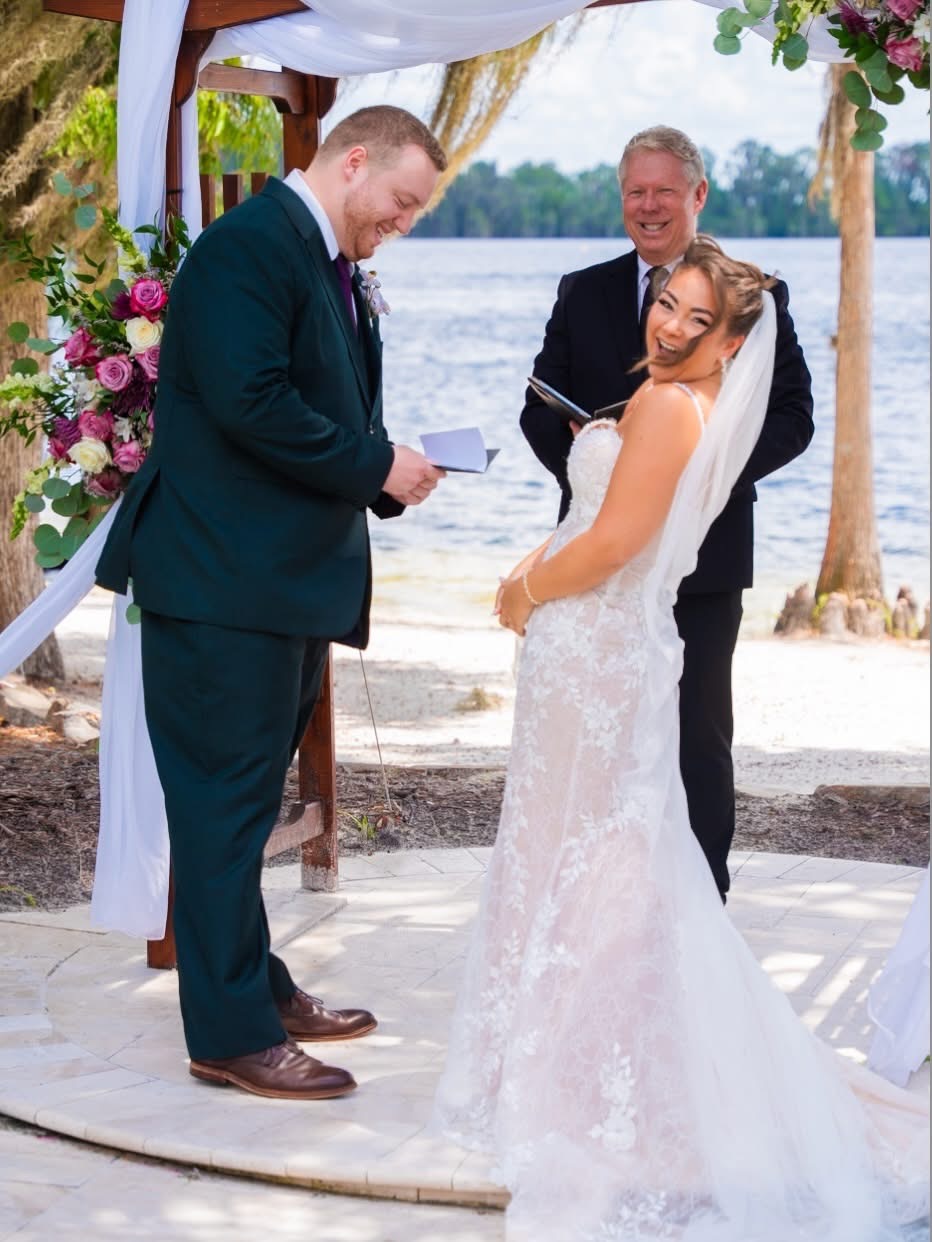
What Questions Should I Ask a Wedding Officiant Before Hiring?
What Questions Should I Ask a Wedding Officiant Before Hiring?
Choosing a wedding officiant can sometimes feel like one of the easier decisions you’ll make
when planning your wedding. After all, the officiant may only be involved for 20 or 30 minutes,
right?
Not necessarily.
I’ve been performing weddings for 26 years and have officiated more than 400 ceremonies. I have
performed everything from beachside elopements to formal church weddings, backyard
ceremonies, and just about everything in between. And one thing I learned is that the officiant
you choose can have a much bigger impact on your wedding day than you might expect.
A good officiant can perform the legal requirements and read a prepared script.
A great officiant does much more.
A great officiant communicates well, brings a personal touch to the ceremony, helps you
understand what needs to happen, and knows how to keep things moving when the unexpected
inevitably happens.
If you’re looking for more information about choosing the right person, you can also read our
guide to finding the perfect wedding officiant.
So, before you hire an officiant, here are seven questions I recommend asking.
1. How much experience do you have officiating weddings?
Experience matters.
That doesn't mean you should automatically hire the officiant who has performed the most
weddings. But there is something to be said for having someone standing beside you who has
seen a few things before. After more than 400 weddings, I've learned that weddings rarely go
exactly as planned. That's not necessarily a bad thing. In fact, some of the most memorable
moments happen when something unexpected occurs.
Consider one wedding where the couple had a very specific vision: they wanted their dog to
serve as the ring bearer.
Everything went beautifully—until the couple kissed.
The moment they kissed and were pronounced husband and wife, their dog apparently decided
that the ceremony was over and it was time to get to his owners. He went wild trying to reach
them. Fortunately, the couple had thought ahead. Someone was ready to scoop up the dog as the
newly married couple recessed down the aisle.
Problem solved.
That’s an important lesson: a good wedding professional doesn’t assume everything will go
perfectly. They have a plan for when it doesn’t.
Ask an officiant how many weddings they’ve performed and what types of ceremonies they’ve
handled. Their answer can tell you quite a bit about the experience you're likely to have.
2. Can you customize the ceremony to fit us?
This is one of the most important questions you can ask.
Your wedding ceremony shouldn’t feel like something that could have been performed for any
couple.
Ask the officiant:
Can we write our own vows?
Can you help us write or refine our vows?
Can we include readings, stories, poems, or special traditions?
Can we include religious elements?
Can we create a ceremony that reflects our personalities?
How much input will we have in the ceremony?
One of the great advantages of hiring a professional officiant is the ability to tailor the
ceremony to you. You may be people of deep faith. You may have no particular religious
affiliation. You may fall somewhere in between.
There isn’t one perfect wedding ceremony.
A great officiant should be willing to listen to you and help create a ceremony that reflects who
you are as a couple. In my opinion, an officiant who won’t help you create personalized elements
of your ceremony is a red flag.
You’re not hiring someone simply to stand at the front and read words. You’re hiring someone to
help create one of the most meaningful moments of your wedding day.
3. Can I see reviews and/or video examples of ceremonies you've performed?
Don’t be afraid to ask. You might ask to see reviews from previous couples or, where
appropriate, video examples of ceremonies the officiant has performed. Reviews can tell you
about things that aren’t obvious from a website:
Did the officiant communicate well?
Were they professional?
Did they make the couple feel comfortable?
Did they personalize the ceremony?
Were they prepared?
You should also pay attention to how the officiant responds to your questions.
Someone who welcomes the opportunity to explain their process and show you examples of their
work is giving you useful information about what it will be like to work with them.
4. What’s included in your fee?
Of course, you should know what you’re paying. Ask about the officiant’s fee, but don’ make
price the only factor in your decision. Find out what’s included.
Does the fee cover the initial consultation? Ceremony planning? Rehearsal participation? Travel?
Assistance with vows? Coordination with your wedding planner? Help understanding the
marriage license process?
The cheapest officiant isn’ necessarily the best value.
In fact, an unusually low price can sometimes be a yellow flag.
There’s nothing wrong with finding an officiant who fits your budget. But remember that you're
paying for more than the few minutes the officiant spends standing in front of your guests.
You’re paying for preparation, experience, communication, professionalism, and the ability to
handle the unexpected.
5. How will you help us with the marriage license?
This is a question many couples don’t think to ask.
The marriage license process can be confusing, particularly for couples who haven't been
married before. The exact requirements vary depending on where you are getting married, so
your officiant should be able to explain the basics of what you need to know and help you
understand your responsibilities. A great officiant doesn’t necessarily handle every part of the
process for you, but they shouldn’t leave you wondering what you’re supposed to do.
Ask:
Where do we get our marriage license?
When should we get it?
What do we need to bring?
Who is responsible for completing and returning it?
What does the officiant need from us?
The ceremony may be the part everyone remembers, but making sure the marriage is properly
and legally documented matters too.
6. How will you make our ceremony personal?
This question gets to the heart of what separates a good officiant from a great one.
Anyone can read a script.
Speaking naturally, with the right inflection, tone, confidence, and emotion, takes skill.
And perhaps just as importantly, the officiant needs to know when to talk and when to get out
of the way.
The ceremony belongs to the couple.
A great officiant should take time to get to know you. They should want to understand your
story, your personalities, your relationship, and what matters to you.
For couples of faith, the ceremony may also be an opportunity to honor God and reflect their
beliefs about marriage. For others, the ceremony may look very different.
The perfect ceremony is the one that matches you.
That’s why some of my favorite weddings have been small backyard ceremonies.
Some couples simply want a small group of their closest friends and family at their home,
sometimes overlooking a beautiful pool or lake. They don’t need a huge guest list or an elaborate
production. But being surrounded by the people they loved most felt incredibly meaningful.
Your wedding doesn’t have to be big.
It needs to match you.
If you’re considering an intimate ceremony, elopement, backyard wedding, or another less-
traditional celebration, explore the ceremony options available through Sensational Ceremonies.
7. How will you work with our wedding planner or coordinator?
Here’s something else couples sometimes misunderstand: your officiant is not your wedding
planner. The officiant’s primary responsibility is to create and perform a legal ceremony—and,
for couples of faith, a God-honoring ceremony—that reflects who you are as a couple.
Your wedding planner or coordinator has a different role.
But that doesn’t mean your officiant and planner shouldn’t work together.
Quite the opposite.
One of the greatest blessings for an officiant is having an organized wedding planner or
coordinator. When everyone knows where they need to be, when things are supposed to happen,
and what their responsibilities are, the ceremony is much more likely to run smoothly.
Ask your officiant how they communicate with planners and coordinators and whether they’re
willing to participate in a rehearsal or coordinate important details ahead of time.
You don’t want your officiant trying to become the wedding planner.
You do want an officiant who understands that they’re part of a larger team.
One More Question: Why Should We Hire You?
This may be the most revealing question of all.
Ask the officiant why they believe they’re the right person for your wedding.
Then listen carefully.
Are they focused entirely on their own credentials?
Do they immediately talk about price?
Or do they start asking questions about you?
The right officiant should want to know your story.
They should want to understand what kind of ceremony you're envisioning.
They should care about what matters to you.
And they should be confident enough in their experience to help you create something
meaningful without making the ceremony about themselves.
A couple asked a teacher friend to officiate their wedding because the friend was a good speaker
and offered to do it for free. The teacher ended up speaking for an hour. I’m sure the teacher had
good intentions, but public speaking and officiating a wedding are not necessarily the same
thing. A wedding ceremony requires more than being comfortable in front of a crowd. It requires
judgment, timing, preparation, confidence, appropriate tone, and an understanding of the
significance of the moment.
The Bottom Line
When you’re choosing a wedding officiant, don’t simply ask, “How much do you charge?”
Ask questions that help you determine whether this person will be a good fit for you.
Ask about experience.
Ask about customization.
Ask about reviews.
Ask about vows.
Ask about the marriage license.
Ask about their approach to the ceremony.
And ask how they will work with the other professionals involved in your wedding.
Most importantly, pay attention to how they communicate.
After 26 years and more than 400 weddings, I believe two things separate a good officiant from a
great one: communication skills and a personal touch.
Your wedding ceremony may only last a short time, but it is the moment when you publicly
become husband and wife. Choose someone who understands the importance of that moment,
and who will work with you to make it uniquely yours.
It needs to match you.
Getting Married in Houston?
If you’re planning a wedding in Houston, The Woodlands, Galveston, Sugar Land, Katy, Spring,
Cypress, or the surrounding Houston area, I’d love to talk with you about your ceremony.
At Sensational Ceremonies; Houston, we believe your ceremony should be personal, meaningful,
and reflective of who you are; not a generic script.
Whether you’re planning a formal church wedding, an intimate backyard ceremony, a lakeside
celebration, an elopement, or something completely unique, let’s talk about what you have in
mind.
Your wedding doesn’t have to look like everyone else’s. It needs to look like you.
Request a complimentary consultation with a Houston wedding officiant, and let’s start creating a
ceremony you’ll remember for the rest of your lives.

Dr David Lorenz – Sensational Ceremonies